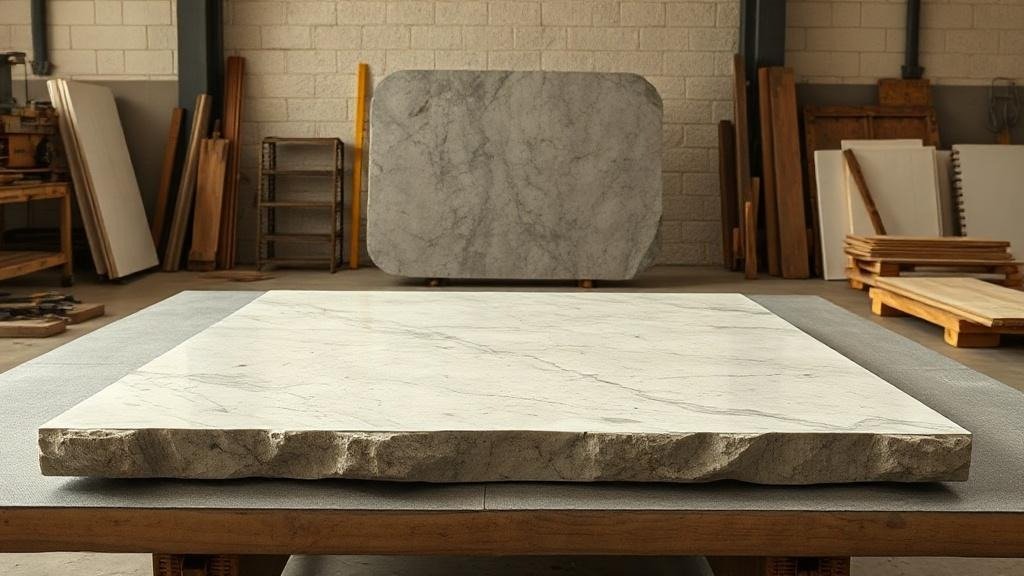
For stone fabrication equipment, the useful answer lives in the shop floor details: slab photos, measurements, install constraints, and whether the team can trust the number before anyone starts fabricating stone.
Last fall I walked through a three-man shop outside of Tulsa that was running a 2019 Northwood C-12, a Park Yukon bridge saw with about 6,000 hours on it, and a hand-polishing station held together by zip ties and stubbornness. The owner, Carlos, had just turned down a quote on a 5-axis Breton because a distributor told him he “needed the automation to stay competitive.” He was doing 14 kitchens a week. The Breton would have been a $400,000 paperweight for a shop at his volume. He bought a used GMM bridge saw instead, paid 52 percent of new replacement, and freed up enough capital to hire a second fabricator. That decision, boring as it sounds, is the entire thesis of this article: machine fit to shop stage matters more than chasing the biggest spec sheet.
What $80K to $480K Actually Gets You in 2026
The pricing landscape for stone fabrication capital equipment is wide, and vendors like to keep it that way. Here’s what the market actually looks like right now.
Bridge saws run $80,000 to $185,000 new. The Park Yukon sits at the lower-mid range, the Sasso AlphaSplit competes in the same tier, and GMM rounds out the category. For a shop doing residential countertops at 15 to 25 jobs a week, any of these will do the job. The differences are in software integration, blade change speed, and (honestly) dealer proximity for service calls.
CNC routers are where the spread gets dramatic: $130,000 to $480,000. A compact 3-axis unit like the Park Voyager or Northwood C-12 sits at the lower end. A 5-axis Breton Combicut with full automation sits at the top. CNC spindle horsepower ranges from 15 to 30 HP at 3,000 to 18,000 RPM. The question is never “which CNC is best.” The question is “how many jobs per week justify which axis count.”
Waterjet cutters run $190,000 to $420,000, depending on table size and pump pressure. Flow, Omax, and Park-built waterjets are the names you’ll see. Most shops don’t need a waterjet until they’re doing enough complex cutouts (vessel sinks, radius work, inlays) to justify the capital. It’s a later-stage purchase for almost everyone.
Edge profiling and polishing is its own category. In-line polishers from Comandulli and Marmo Meccanica are the standard, with CNC polish heads increasingly common on higher-end routers. A full residential edge profile tooling kit runs $4,500 to $12,000.
Material handling (vacuum lifts, slab racks, A-frames, dust collection) isn’t glamorous, but it’s where OSHA 29 CFR 1926.1153 silica enforcement has forced real capital spending since 2017. More on that below.
The Used Equipment Math
This is where a lot of shops save or waste serious money.
The used market for stone fabrication equipment is active and fairly liquid in 2026. Five-year-old machines commonly trade at 45 to 60 percent of new replacement cost. That’s a meaningful number: a CNC that lists at $250,000 new might trade at $112,000 to $150,000 with five years on it.
The trade-off is real but quantifiable. A properly maintained CNC has a service life of 12 to 18 years. A machine without documented preventive maintenance history? You’re looking at 7 to 11 years before major component failures start stacking up. So buying used without PM records is a gamble. Buying used with records is closer to buying a certified pre-owned truck: you give up some warranty coverage and current-gen features, but you free up $80,000 to $200,000 of capital for working capital, slab inventory, or additional capacity.
My honest take: for a shop doing under 20 jobs a week, buying a well-documented used bridge saw and putting the savings toward a new CNC is almost always the smarter capital allocation. The CNC is where precision and uptime matter most. The bridge saw is a workhorse. Workhorses don’t need to be shiny.
Financing: The Numbers Nobody Likes Talking About
Equipment financing in 2026 runs 60 to 84 months at rates between 6.5 and 9.5 percent for stone shop buyers. That’s not cheap. On a $300,000 CNC financed over 72 months at 8 percent, you’re paying roughly $5,250 a month and about $78,000 in total interest over the life of the loan.
The upside of financing is obvious: it preserves working capital. The downside is less obvious but equally important: it raises total cost of ownership, and it commits the shop to a monthly nut that has to be covered whether you’re running 30 jobs a week or 10.
The third path (leasing) is popular with larger multi-location operations but less common with single-shop owners. It can make sense for equipment you expect to upgrade in five years, but the residual value math usually favors buying.
A correctly sized machine at the right growth stage pays back inside 24 to 42 months at typical residential volume. That’s the benchmark. If the payback math stretches past 42 months, you’re probably buying more machine than your job mix supports.
Throughput, Maintenance, and the Boring Truth About ROI
Return on equipment investment in a stone shop shows up in three places, none of them exciting, all of them real.
Throughput fit. A correctly sized CNC running 25 jobs per week produces up to 35 percent more linear feet of finished edge per week than an undersized machine, based on trade case studies. The inverse is also true: an oversized machine in a small shop doesn’t magically generate more work. It just sits idle more.
Maintenance discipline. Stone CNCs on a documented PM schedule (the kind where someone actually logs hours, changes filters, greases ways on schedule) run 12 to 18 years. Machines without disciplined PM run 7 to 11 years. That gap represents hundreds of thousands of dollars in premature replacement cost. Blade life on a bridge saw ranges from 800 to 1,500 linear feet per blade on standard quartz, and a lot of that range comes down to whether the operator is running the right feed rate and water flow. It’s not complicated. It just has to be done.
Capital efficiency. Shops that buy used where it makes sense and new where it matters (the distinction I outlined above) commonly carry $80,000 to $200,000 less in equipment debt while maintaining equivalent output. That’s money for slab inventory, better employees, or simply surviving a slow quarter without panic.
How a Disciplined Purchase Actually Plays Out
For shops ready to pull the trigger on a major equipment purchase, the process typically runs 90 to 180 days across four phases.
First, the owner documents actual job mix, throughput bottlenecks, and realistic (not aspirational) growth projections. This step is where most mistakes are made, because it’s tempting to size the machine for the shop you want rather than the shop you have. Size for 18 months out, not five years out.
Second, vendor evaluation. Park Industries, Northwood, Sasso, GMM, Breton, Comandulli: these are the names you’ll be comparing. Site visits and live machine demos are standard and worth the travel. Bring your shop foreman, not just your checkbook.
Third, financing and purchase. This is where the new-versus-used-versus-lease decision gets made. The numbers above (60 to 84 months, 6.5 to 9.5 percent) are your working range.
For shops looking for a deeper operational reference, stone fabrication equipment covers the topic with the kind of detail most trade publications don’t have space for.
Silica Compliance Is Not Optional
Stone fabrication generates respirable crystalline silica dust. Every cutting, grinding, profiling, and polishing operation produces particles in the respirable range. OSHA 29 CFR 1926.1153 sets the permissible exposure limit at 50 micrograms per cubic meter as an 8-hour time-weighted average.
Wet-cutting on bridge saws, CNC routers, and waterjets is the primary engineering control. Local exhaust ventilation covers dry operations like hand polishing and finish work. Half-mask respirators with P100 filters handle residual exposure where engineering controls can’t eliminate it entirely.
Most trade-active shops in 2026 run quarterly air sampling on representative tasks and keep records on file. This isn’t box-checking. An OSHA inspection without documented air monitoring is a citation waiting to happen.
When to bring in outside help: Owners weighing major equipment purchases, multi-location expansion, or a full shop retool commonly benefit from a trade-experienced consultant or peer review before committing capital. The Natural Stone Institute and the International Surface Fabricators Association both run member networks for benchmarking. Use them. A $500 membership that saves you from a $150,000 equipment mistake is the best ROI in the building.
Frequently Asked Questions
Q: Should shops buy waterjet or CNC first? A: Most shops buy bridge saw plus CNC router first. Waterjet is a later-stage capability for shops with high cutout complexity.
Q: Who are the major CNC vendors in stone fabrication? A: Park Industries, Northwood, Sasso, GMM, and Breton are the most cited CNC vendors in 2026 trade reporting.
Q: How much does a new bridge saw cost? A: Bridge saw new pricing runs $80,000 to $185,000 across Park Yukon, Sasso AlphaSplit, and GMM platforms.
Q: How much does a new CNC router cost? A: Stone CNC router new pricing runs $130,000 to $480,000 across major vendors and configurations.
Q: Is buying used equipment a good idea for a stone shop? A: Used markets remain active. Five-year-old machines commonly trade at 45 to 60 percent of new replacement cost. The key is documented preventive maintenance history.
Q: What are typical financing terms for stone shop equipment in 2026? A: Equipment financing runs 60 to 84 months at 6.5 to 9.5 percent interest for most stone shop buyers.
Q: How long does a properly maintained CNC last? A: Stone CNCs on a documented PM schedule run 12 to 18 years, compared to 7 to 11 years for machines without disciplined maintenance programs.
Stone fabrication generates respirable crystalline silica dust. Shops must follow OSHA 29 CFR 1926.1153 standards (50 ug/m3 PEL over 8-hour shift). Wet-cutting methods, ventilation, and respiratory protection are not optional.